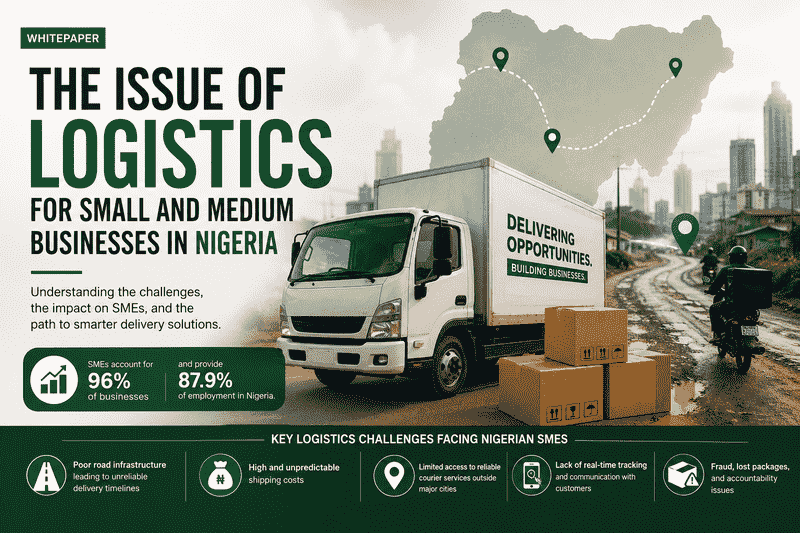
Across Nigeria, business owners keep running into the same wall: logistics. Sometimes a customer can’t afford to receive their order because the delivery fee costs more than the product itself. This usually comes down to distance, the farther a customer is from the vendor, the more they pay to get their item delivered.
When that happens, the customer has to weigh their options. If the purchase isn’t urgent, they may cancel the order altogether, especially if a cheaper alternative is available closer to home. Vendors who haven’t found a way to stand out through better pricing, faster delivery, or a stronger customer experience often lose these customers to high delivery fees alone. This plays out most often in big cities like Lagos, Abuja, and Port Harcourt, where distance and traffic both drive costs up.
And that’s just within a single city. For deliveries between states, many vendors have to combine shipments with other customers just to bring the cost of each delivery down.
This is a growing concern as Nigeria’s business economy expands. Fuel prices are high, and moving goods has become harder for businesses and individuals alike.
The State of SMEs in Nigeria Today
Small businesses are the backbone of Nigeria’s economy. As of December 2021, at least 39.65 million micro, small, and medium enterprises (MSMEs) were operating in the country, part of a global pool of roughly 400 million small businesses worldwide.
These are not just numbers, they represent economic weight. In Nigeria, SMEs make up 96% of all businesses and account for 87.9% of employment. A healthy small business sector generally points to a healthy economy overall, which makes the problems these businesses face worth paying close attention to.
Despite their scale, survival isn’t guaranteed. Industry research suggests only about one in five Nigerian SMEs stays in business beyond five years, a signal that the everyday challenges they face (logistics included) carry real consequences.
Why More SMEs Are Moving Online or Expanding Delivery-Based Sales
Social media has become one of the most effective ways for small businesses to reach customers. As of January 2023, Nigeria had 31.60 million social media users, about 14.3% of the population, and a rapidly growing base of potential customers.
The impact is measurable. Research shows that strong social media strategies can account for 52.4% to 73.2% of the variance in financial performance and revenue growth among Nigerian SMEs. Selling online opens doors that a physical shop simply can’t, and vendors can now reach customers they’d never have met otherwise.
But there’s a catch, once the order comes in, someone still has to deliver it. And that’s where many businesses hit a wall. Growing your customer base online is only half the job, you also need a way to get the product into their hands reliably. Without solving that, scaling becomes very difficult.
Key Logistics Challenges Facing Nigerian SMEs
Poor road infrastructure leading to unreliable delivery timelines: Bad roads slow everything down. Business owners who ship goods regularly report that traffic and poor road conditions directly affect delivery times, and for anyone shipping perishable goods, delays can mean lost inventory, not just lost time.
High and unpredictable shipping costs: According to World Bank estimates, trade costs in Nigeria run four to five times higher than in many developed countries. On top of base delivery fees, vendors often face extra charges for packaging, insurance, remote-area delivery, and failed-delivery return trips, costs that are hard to predict and even harder to plan around.
Limited access to reliable courier and delivery partners outside major cities: Most established logistics providers concentrate their coverage in large cities. Vendors serving customers in smaller towns or rural areas often have far fewer reliable options, if any at all.
Lack of real-time tracking and communication with customers: Many smaller couriers still operate without proper tracking systems, leaving both the vendor and the customer in the dark about where a package actually is.
Fraud, lost packages, and accountability issues: Without tracking or clear accountability, packages can go missing with little recourse for the business or the customer, damaging trust on both sides.
The Business Impact of These Challenges
This issue of logistics doesn’t just inconvenience the vendors, it largely affects the economy. This is what the data says about how much this issue actually costs.
Nigeria’s logistics inefficiencies, like poor roads, unreliable electricity, and outdated port and customs systems, are estimated to cost the country $8 billion a year, including $5.8 billion in corporate earnings lost by companies that depend on major ports. They look like abstract losses, but they trickle down into higher prices, slower deliveries, and tighter margins for the SMEs operating within that system. It’s also worth noting that Nigeria currently ranks 88th on the World Bank’s Logistics Performance Index, a measure of how efficiently a country moves goods. Singapore holds the number one spot.
For many small businesses, the real turning point came after the fuel subsidy was removed in 2023, when delivery costs climbed sharply. Delivery costs for everyday e-commerce orders more than doubled, and in some cases tripled. In parts of Lagos, for example, delivery fees that once ranged between ₦400 and ₦1,800 rose sharply as fuel prices climbed past ₦1,025 per litre. For a small vendor selling low-margin goods, that kind of jump can wipe out any profit on an order entirely.
Imagine selling a product for ₦5,000 with a modest profit margin of ₦1,000. Before the subsidy removal, a delivery fee of around ₦600 was easy to absorb or pass on without much resistance. But once that same delivery jumps to ₦1,800, the vendor is left with two bad options: walk away with no profit, or pass it on to the customer and risk losing the sale altogether. Either way, a business that was barely breaking even now finds itself losing money just to keep a customer happy.
Even without external shocks like fuel prices, everyday traffic in cities like Lagos inflates the cost of doing business. In dense urban markets, traffic bottlenecks alone can add up to 30% to fulfillment costs compared to more structured markets, while also stretching delivery windows by several hours. Poor or informal addressing of the issue compounds it, leading to failed drop-offs and costly re-routing.
Beyond what it costs to get a package moving, there’s the added expense of getting it there at all. Global data gives a useful benchmark for how expensive a “failed delivery” really is. On average, 5–10% of deliveries fail on the first attempt worldwide, and up to 20% of online orders contain incorrect or incomplete address details, a problem that’s especially common in Nigeria, where formal street addressing is inconsistent in many areas. Each failed attempt forces a business to absorb the cost of a second delivery try, on top of the first.
Cost aside, there’s a harder-to-measure impact on businesses: trust. Customer trust doesn’t survive repeated failures. Globally, 84% of consumers say they won’t return to a brand after a poor delivery experience. In the Nigerian context, this shows up as customers switching to “pay on delivery” and pickup-center visits specifically to avoid high delivery fees, signalling that delivery friction directly shapes buying behavior, not just satisfaction scores.
If logistics costs can push a company as large as Jumia to a reported $20.2 million operating loss in a single quarter, it is reasonable to assume the impact on a small, cash-strapped vendor, with none of that scale or cushion, is proportionally far more damaging and pathetic.
Put together, these numbers point to a pattern that shows up time and again in conversations with Nigerian vendors. High and unpredictable delivery costs, failed or delayed shipments, and delivery errors all combine to limit how far a small business can reasonably expand its delivery radius. Many vendors choose to stay within their immediate city or region, not because there’s no demand further out, but because the cost and risk are not yet worth it.
What SMEs Are Currently Doing to Cope
Using multiple couriers to reduce risk: Rather than relying on one delivery partner, some vendors spread their shipments across several couriers, hoping at least one comes through reliably. This is because putting all eggs in one basket may cause disappointment; the trusted delivery guy may be unavailable, the delivery prices are different on different days, and other uncertainties to deal with.
Passing shipping costs to customers: To protect their margins, many businesses pass delivery costs directly to the buyer, which, as covered earlier, can drive customers away if the fee feels too high relative to the product.
Relying on informal delivery networks: Okada (motorbike) riders and personal contacts fill a real gap, especially for last-mile or same-city delivery. They’re often faster and cheaper for short distances, but they come with no tracking, no insurance, and no guarantee of consistency.
Are these workarounds really sustainable long-term?
Each of these methods solves a problem in the short term but creates new ones. Juggling multiple couriers adds administrative work. Passing on costs risks losing price-sensitive customers. Informal networks can’t scale, and they leave no paper trail if something goes wrong. None of these approaches give a business the steady, predictable delivery system it needs to scale.
What a Better Logistics System Looks Like
Nigeria isn’t the first place to wrestle with expensive, unreliable last-mile delivery. Other markets have faced similar pressure and have tested solutions worth paying attention to.
Parcel lockers and pickup points: In parts of Europe, the rise of neighborhood parcel lockers and pickup points has cut failed deliveries by as much as 40%. Instead of a courier making repeated attempts at someone’s door, the customer picks up their package on their own schedule from a secure, central location. For Nigerian cities where addressing is inconsistent and “the customer wasn’t home” is a common cause of failed delivery, a similar model- lockers at markets, estates, or fuel stations closer to the customers- could meaningfully cut down on these trips.
Crowdsourced delivery networks: Rather than relying on a single fixed fleet, some companies now tap into networks of independent riders and drivers who pick up delivery jobs as they become available, similar to how ride-hailing works. This approach has extended delivery reach into rural and remote areas without the cost of maintaining a large permanent fleet. Nigeria already has an informal version of this in okada riders, the opportunity lies in bringing structure, tracking, and accountability to that existing network.
Address verification technology: Since incomplete or incorrect addresses are a leading cause of failed deliveries worldwide, some markets have adopted digital address-verification tools that convert a location into a simple, precise reference point, useful in places where formal street addresses don’t exist or aren’t reliable. Given how widely acknowledged unreliable addressing is as a Nigerian logistics problem, this is one of the more directly transferable fixes.
Micro-fulfillment and smaller, local hubs: Instead of shipping every order from one central warehouse, some retailers now stock smaller, strategically placed hubs closer to where customers actually are. This shortens the distance, and therefore the cost and time, of the final delivery leg. Applied locally, this could mean vendors or logistics providers stocking popular items in multiple neighborhood hubs across a city like Lagos, rather than routing every delivery from a single point.
Route optimization powered by data: AI-assisted route planning that adjusts in real time for traffic, weather, and order density has helped delivery companies elsewhere cut fuel costs and meet delivery windows more consistently. In a city where traffic alone can add up to 30% to delivery costs, smarter routing has real, immediate cost-saving potential and is not just a “nice to have.”
None of these solutions require reinventing logistics from scratch. They’re proof that the core problems Nigerian SMEs face have been tackled successfully elsewhere, and the models exist to be adapted rather than invented.
The Way Forward
Solving this problem isn’t the job of any single group. Vendors, logistics providers, and policymakers each have a role to play. This is what meaningful progress could look like from each side.
Individual business owners:
- Get precise about location. Since unreliable addressing is one of the biggest causes of failed delivery, something as simple as sharing exact GPS coordinates or a clear landmark alongside every order can cut down on wasted trips.
- Batch and combine deliveries where possible. Grouping orders heading to the same part of town, or coordinating with other small vendors doing the same, brings per-delivery cost down, the same logic behind interstate delivery pairing.
- Be transparent with customers about delivery costs upfront. Surprise fees are a major driver of cancelled orders. Showing the real cost early, even if it’s high, builds more trust than a last-minute surcharge.
- Track delivery performance, not just sales. Knowing which routes or couriers fail most often lets a vendor make informed decisions the next time.
- Explore multiple delivery channels, including informal riders for short distances and formal couriers for longer ones, while keeping records of what each option actually costs and how often it succeeds, rather than defaulting to whichever is most familiar.
Stores offers all these and more. As a business owner, you can create an online store, manage inventory, and ship all from one place. You don’t have to bother searching for riders or couriers, as you can automatically see them and their prices on your shipment page after inputting your order. You also get a tracking code where you and your customer can know exactly where the product is.
Logistics providers and platforms:
- Invest in address verification and clear location systems: especially for high-density but informally addressed areas.
- Offer transparent, predictable pricing: so vendors can plan costs in advance instead of absorbing sudden increases.
- Build structured networks around existing informal delivery labor: riders and drivers already serving these routes, rather than trying to displace them, adding tracking and accountability on top of what already works.
- Extend coverage beyond major cities, even gradually, since so much of the current gap is in access outside major cities like Lagos, Abuja, and Port Harcourt.
Policymakers and infrastructure stakeholders:
- Prioritize road maintenance on routes with high commercial delivery traffic, since poor roads are consistently cited as a root cause of delay and cost.
- Support formal, consistent street addressing systems, particularly in fast-growing residential areas where informal addressing currently causes the most failed deliveries.
- Encourage competition and investment in the logistics tech sector, which has already grown to include hundreds of logistics-tech ventures in Nigeria, a sign the appetite for solving this exists, but needs continued support to scale.
No single fix will solve Nigeria’s logistics problem overnight. But small, deliberate steps stack up. Progress here won’t come from one company or one policy but from everyone playing their part.
Conclusion
Logistics is one of the biggest, and most under-discussed, obstacles standing between Nigerian SMEs and real growth. It affects whether a sale goes through, whether a customer comes back, and ultimately, whether a business can expand beyond its immediate neighborhood. With SMEs making up the vast majority of businesses and employment in Nigeria, solving this problem isn’t just good for individual vendors, it also strengthens the wider economy.
If you’re a business owner still relying on multiple couriers, informal riders, or manual shipping processes, it’s worth revisiting that approach with fresh eyes, the cost data makes clear how much is at stake. And for the logistics providers, developers, and policymakers reading this, the models that have worked elsewhere are proof that this problem is solvable. What’s needed now is the will to adapt them to Nigeria’s realities.
Leave a Reply